Ernest Osogbue.
_This story was first published in Vanguard Newspapers of December 1st 2018. It is only reproduced here, with slight modifications for record purposes._
This year marked the 19th (26th) anniversary of civilian rule, albeit democracy in Nigeria. Never in the history of the country has there been such a long uninterrupted rule by ‘bloody civilians’ without the all-knowing Nigerian military stepping in to stem the alleged negative drift.
First, it was in January 1966, when a group of Majors in the Nigerian Army, led by Chukwuma Kaduna Nzeogwu, ousted the civilian government of Abubakar Tafawa Balewa. Then in July of the same year, a counter coup, that ultimately led to the fratricidal Nigerian civil war. When the war ended in 1970, the then Head of State, General Yakubu Gowon declared that there was no victor and no vanquished.
On July 30th 1975, Gowon was overthrown by members of his own government, with General Murtala Mohammed emerging as Head of State. An unsuccessful coup on February 13th 1976, led to the assassination of Mohammed, and the baton fell on General Olusegun Obasanjo to lead the nation. He then successfully midwifed a return to civilian rule in 1979.
This civilian rule was short-lived, as another coup on December 31st 1983 swept away the government of Shehu Shagari, and brought in General Mohammadu Buhari. Buhari himself was to suffer the fate of Yakubu Gowon, when senior members of his government overthrew him on August 27th 1985.
General Ibrahim Babangida emerged from this coup, as Head of State, and remained in office until August 26th 1993, when he was pressured into handing over leadership to an unelected civilian Ernest Shonekan, as a result of the impasse, following the annulment of the June 12th 1993 presidential election. General Sani Abacha, only allowed Shonekan’s government to last three months, before dismantling it, and taking over as Head of State on November 17th 1993. General Abacha’s sudden death on June 8th 1998 paved the way for General Abdulsalami Abubakar to assume office as Head-of-State, and subsequently midwifed our current democratic experience.
A critical look at the above leadership sequence would yield the fact that since independence in 1960, military rule was prevalent in Nigeria until 1999. Nigeria was officially under colonial rule from 1914 to 1960 when she became independent from British rule; by 1966 there was a military coup, with the military remaining in power for 13 years, until 1979, before being briefly interrupted for 4 years, between 1979 and 1983. The military then came back to power in 1984, and stayed in power for another 16 years until 1999. This means that between 1966 and 1999, a period of 33 years, Nigeria was under military rule for a whooping 29 years.
While Nigerians have been screaming at the slow pace of political and economic development of the country, and have been making efforts to find the reasons why civilian rule or democracy has not yielded the expected results, one factor that has been overlooked as being a challenge to democratic development is ‘military mentality’.
Democracy presupposes a civilian government based on procedures, where the constitution as the supreme law of the land, holds sway at all times, with nobody being above the law, and everyone being equal before the law, and with the law being impartial. As our democratic system has unfolded since 1999, is it possible for Nigerians to beat their chests and say that the above three elements of democracy have been in place?
I have taken a careful look at our development, and discovered that outside of the millennials- those born since the year 2000-, most other Nigerians have experienced one form of oppressive rule or the other. Nigerians born before 1960, were born under colonial rule, while those born before 1999/2000 were born, or grew up under military rule. Being born, growing up, and living under oppression has therefore shaped the mentality of the past and present generations of Nigerians, thereby affecting their attitudes, their thinking, their response to issues, and general behavior.
A careful observer would notice that the average Nigerian has a tendency to behave in a military fashion; we are either rushing in a panic, or urging those ahead to give way to us, or get bulldozed out of the way. This shows in our everyday life of impatience, characterized by such terms as ‘now now’, ‘quick quick’ and ‘sharp sharp’. A walk down a street in Abuja or in Lagos, or indeed any major city in the country, is a nightmare for anyone who has ever lived in a civilized environment. Driving on the roads is no better, as most Nigerian drivers act like animals in the jungle, jostling one another for space on the highways, as if driving on the road is a battle.
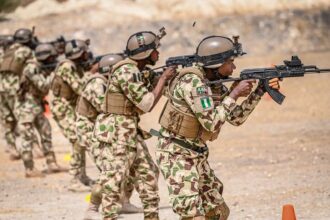
Long years of military rule have battered the psyche of the average Nigerian into erroneously believing the false mantra of; the quicker the better. The average citizen has also unknowingly accepted that all things military are superior to all things civil, inadvertently leading to the militarization of the mentality of the Nigerian population.
The command and obey structure of the military, which brooks no arguments, and abhors alternative ideas, has pushed the average Nigerian into unconsciously accepting that following procedures is a sign of weakness, and that might is always right. In our daily lives, this phenomenon manifest when citizens wantonly disobey traffic rules, disrespect each other, jump the queue, drive against traffic, and blatantly offer and accept bribes in order to circumvent official procedures.
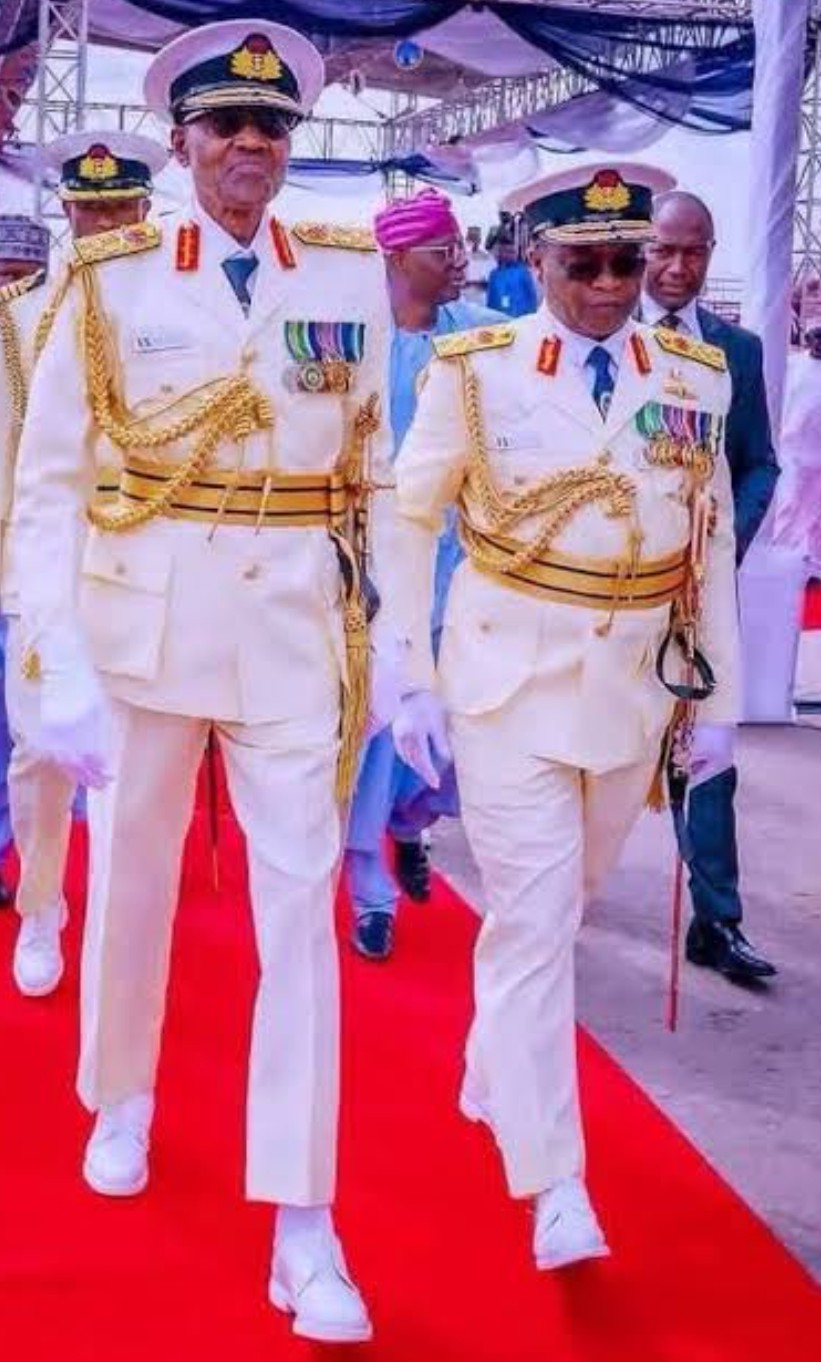
In governance it is manifest when democratically elected officials drive on the highway with a long siren blaring convoy, chasing those who put them in office out of the way. It is also manifests when a democratic president appears in public flanked by an army officer in full military regalia, either as an ADC or an orderly. State governors have uniformed police officers flanking them as orderlies at all public functions, as a manifestation of their power and authority
Other manifestations of military hangover in governance includes, but is not limited to the perception that the president owns the country, and has unlimited powers, to the exclusion of state governors, and local government chairmen. It also manifests in our attitudes in public places, when we shout at and disrespect each other, leave our phones ringing at its loudest, and shout while answering the call without caring about our neighbors. We shout at our children at home, we shout at our husbands, and shout at our wives in the presence of our children. We leave our car horns blaring at all times, and use it as a weapon against other road users. Governance is mostly centralized at the state and federal levels, with little or no recourse to accountability. These and other tendencies expose our lack of understanding of democracy.
Police officers arrest and detain citizens without bringing them to trial in line with the law, and suspects are left languishing in detention for months incommunicado. The military and other mushroom quasi-military organizations arrest and detain citizens without recourse to the laws of the land. The question now is; how can democracy be deepened, and the so-called dividends of democracy get to the people, when the people themselves are daily involved in the raping of democracy?
While leaders at various levels may be culpable in the institutionalization of military mentality in our democracy, it is pertinent to point out that the average citizen must take his own share of the blame. When attitudes which undermine our democracy, weaken democratic institutions, and go against procedures, become accepted as norms, the end product for such a society is anarchy.
It becomes pertinent therefore, to remind those in positions of authority, as well as ourselves, that democracy is not a product, but a process. It is the attitude of citizens that deepens democracy. Citizens cannot openly challenge the judgement of the Supreme Court, openly contest the opinions of democratic institutions, and then turn around to shout about institutional failures. Institutions succeed when citizens accept their opinions irrespective of whether it is in their favor or not.
Those in authority must also learn to do away with attitudes carried over from military governance, and imbibe the virtue of accountability. Democratic leaders going about with military and police ADC’s, and orderlies, give democracy a bad name. Democracy presupposes the respect for the law, the respect for one another, and the love for country.
Expecting immediate results is not a democratic norm, we must all therefore, acquire the virtue of patience. Our democracy can only thrive and be deepened, when we make deliberate efforts to water, nurture, and patiently allow it to grow, ripen and bear fruits, whose dividends would accrue to all citizens. Conversely, when we accept attitudes and behaviors that undermine democracy, and when we applaud such behaviors that are contrary to democratic norms, it sends a message that we are unpatriotic, and that we prefer anarchy and the destruction of our country to democracy and the rule of law.